Text of page 94
and plan missions in view of priority and feasibility, to maintain
the operation on a continuing basis, and to carry out the dissem-
ination of the resulting information in a manner consistent with
its special security requirements.*
When the U-2's development and testing approached comple-
tion, Land's recommendation was put into effect. Following a meet-
ing with Deputy Secretary of Defense Donald Quarles and Trevor
Gardner (who had been promoted from his special assistant post to
become Assistant Secretary of the Air Force for Research and
Development), Richard Bissell established an Ad Hoc Requirements
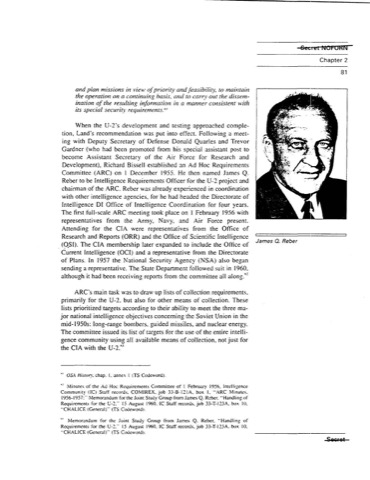
Committee (ARC) on 1 December 1955. He then named James Q.
Reber to be Intelligence Requirements Officer for the U-2 project and
chairman of the ARC. Reber was already experienced in coordination
with other intelligence agencies, for he had headed the Directorate of
Intelligence DI Office of Intelligence Coordination for four years.
The first full-scale ARC meeting took place on 1 February 1956 with
representatives from the Army, Navy, and Air Force present.
Attending for the CIA were representatives from the Office of
Research and Reports (ORR) and the Office of Scientific Intelligence
(OSt). The CIA membership later expanded to include the Office of
Current Intelligence (OCI) and a representative from the Directorate
of Plans. In 1957 the National Security Agency (NSA) also began
sending a representative. The State Department followed suit in 1960.
although it had been receiving reports from the committee all along.""
ARC's main task was to draw up lists of collection requirements.
primarily for the U-2. but also for other means of collection. These
lists prioritized targets according to their ability to meet the three ma-
or national intelligence objectives concerning the Soviet Union in ti
id- 1950s: long-range bombers. guided missiles, and nuclear energ
The committee issued its list of targets for the use of the entire intelli-
gence community using all available means of collection, not just for
the CIA with the U-2.*3
• OSA History, chap. L. annex I (TS Codeword).
* Minutes of the Ad Hoc Requirements Committee of 1 February 1956, Intelligence
Community (IC) Staff records. COMIREX. job 33-8-121A, box I. "ARC Minutes.
956-1957: " Memorandum for the Joint Study Group from James Q. Reber. "Handling of
Requirements for the U-2.* 15 August 1960. IC Staft records, job 33-T-123A. box 10
"CHALICE (General)" (TS Codeword).
* Memorandum for the Joint Study Group from James Q. Reber. "Handling of
Requirements for the U-2." 15 August 1960. IC Staff records. job 33-T-123A. box 10.
"CHALICE (General)" (TS Codeword).
-Secret NOFORN
Chapter 2
81
James Q. Reber
Secret