Text of page 75
-Secret NOFORN
Chapter 2
62
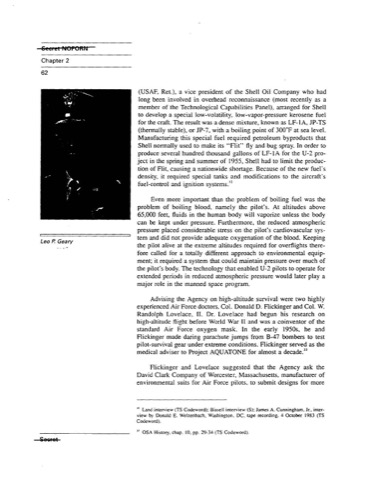
Leo P. Geary
(USAF, Ret.), a vice president of the Shell Oil Company who had
long been involved in overhead reconnaissance (most recently as a
member of the Technological Capabilities Panel), arranged for Shell
to develop a special low-volatility, low-vapor-pressure kerosene fuel
for the craft. The result was a dense mixture, known as LF-IA, JP-TS
(thermally stable), or JP-7, with a boiling point of 300°F at sea level.
Manufacturing this special fuel required petroleum byproducts that
Shell normally used to make its "Flit" fly and bug spray. In order to
produce several hundred thousand gallons of LF-IA for the U-2 pro-
ject in the spring and summer of 1955, Shell had to limit the produc-
tion of Flit, causing a nationwide shortage. Because of the new fuel's
density, it required special tanks and modifications to the aircraft's
fuel-control and ignition systems.
Even more important than the problem of boiling fuel was the
problem of boiling blood, namely the pilot's. At altitudes above
65,000 feet, fluids in the human body will vaporize unless the body
can be kept under pressure. Furthermore, the reduced atmospheric
pressure placed considerable stress on the pilot's cardiovascular sys-
tem and did not provide adequate oxygenation of the blood. Keeping
the pilot alive at the extreme altitudes required for overflights there-
fore called for a totally different approach to environmental equip-
ment; it required a system that could maintain pressure over much of
the pilot's body. The technology that enabled U-2 pilots to operate for
extended periods in reduced atmospheric pressure would later play a
major role in the manned space program.
Advising the Agency on high-altitude survival were two highly
experienced Air Force doctors, Col. Donald D. Flickinger and Col. W.
Randolph Lovelace, II. Dr. Lovelace had begun his research on
high-altitude flight before World War Il and was a coinventor of the
standard Air Force oxygen mask. In the early 1950s, he and
Flickinger made daring parachute jumps from B-47 bombers to test
pilot-survival gear under extreme conditions. Flickinger served as the
medical adviser to Project AQUATONE for almost a decade."
Flickinger and Lovelace suggested that the Agency ask the
David Clark Company of Worcester, Massachusetts, manufacturer of
environmental suits for Air Force pilots, to submit designs for more
* Land interview (TS Codeword): Bissell interview (S): James A. Cunningham, Jr. inter-
view by Donald E. Welzenbach, Washington, DC, tape recording, 4 October 1983 (TS
Codeword).
" OSA History, chap. 10, pp. 29-34 (TS Codeword).
Secret