CIA-UAP-003

The Central Intelligence Agency and Overhead Reconnaissance; The U-2 and OXCART Programs, 1954-1974, page 56

One page of a U.S. government record released under PURSUE, shown on its own with its text. The record page has the whole document, its catalog details and the scan.

Page
56 of 406
Agency
CIA
Released
Release 03, June 12, 2026

Text of page 56

SEcrEt NOFORN Chapter 2 43 at 1717 H Street, NW. Here the staff remained for the next six years until it moved into the new CIA Headquarters building at Langley in March 1962. The final move came in January 1968, when the project staff (by that time known as the Office of Special Activities) moved to the Tyler Building in Tysons Corner, Virginia.' Bissell reported directly to the DCI, although in reality the DDCI, Gen. Charles Pearre Cabell, was much more closely involved in the day-to-day affairs of the overhead reconnaissance project. Cabell's extensive background in Air Force intelligence, particularly in overhead reconnaissance, made him ideally qualified to oversee the U-2 project. Cabell frequently attended White House meetings on the U-2 for the DCI. US FUNDING ARRANGEMENTS FOR PROJECT AQUATONE Although Allen Dulles had approved the concept of covert funding for the reconnaissance project, many financial details remained to be settled, including the contract with Lockheed. Nevertheless, work on the U-2 began as soon as the project was authorized. Between 29 November and 3 December 1954, Kelly Johnson pulled together a team of 25 engineers, which was not easy because he had to take them off other Lockheed projects without being able to explain why to their former supervisors. The engineers immediately began to work 45 hours a week on the project. The project staff gradually expanded to a total of 81 personnel, and the workweek soon increased to 65 hours." Kelly Johnson's willingness to begin work on the aircraft with- out a contract illustrates one of the most important aspects of this pro- gram: the use of unvouchered funds for covert procurement. Lockheed was well acquainted with the covert procurement process, having previously modified several aircraft for covert use by the CIA. Covert funding for sensitive projects simplifies both procure- ment and security procedures because the funds are not attributable to the Federal Government and there is no public accountability for their DDCI Charles Pearre Cabell ' OSA History, chap. 18. pp. 7-8 (TS Codeword): OSA Chronologs. pp. 4. 7, 10. 45 (TS Codeword). * Johnson. "Log for Project X." 29 November-3 December 1951 (U). Secret

Machine-read (OCR) from the scan by this archive; it can contain errors. The scan is the record.
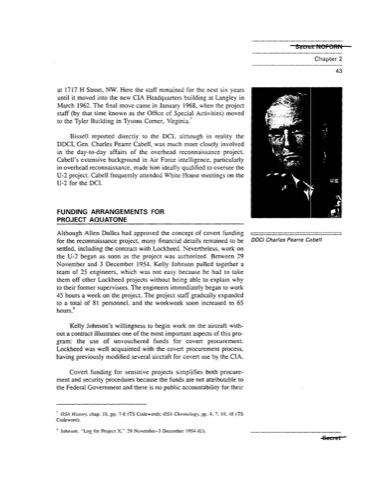
Image from page 56 of CIA-UAP-003, as released by war.gov
Image from page 56 of the PDF. Open the scan to see the whole page.

Cite this page

Central Intelligence Agency. "The Central Intelligence Agency and Overhead Reconnaissance; The U-2 and OXCART Programs, 1954-1974" (CIA-UAP-003). PURSUE Release 03, U.S. Department of War, June 12, 2026. https://www.war.gov/medialink/ufo/061226/release_03/documents/CIA-UAP-003-THE_CENTRAL_INTELLIGENCE_AGENCY_AND_OVERHEAD_RECONNAISSANCE-THE_U-2_AND_OXCART_PROGRAMS_1954-1974.pdf. Declassified UAP, page 56, https://declassifieduap.org/r/cia-uap-003-the-central-intelligence-agency-and-overhead-reconnaissance-the-u-2-and-oxcart-programs-1954-1974/p/56. Accessed November 28, 2026.

This address shows page 56 on its own; /r/cia-uap-003-the-central-intelligence-agency-and-overhead-reconnaissance-the-u-2-and-oxcart-programs-1954-1974?page=56 opens the same page in the full reader. Both stay. How to cite.