CIA-UAP-003

The Central Intelligence Agency and Overhead Reconnaissance; The U-2 and OXCART Programs, 1954-1974, page 42

One page of a U.S. government record released under PURSUE, shown on its own with its text. The record page has the whole document, its catalog details and the scan.

Page
42 of 406
Agency
CIA
Released
Release 03, June 12, 2026

Text of page 42

the task of investigating the nation's intelligence capabilities. Its chairman was Edwin H. (Din) Land, the inventor of the polarizing fil- ter and the instant camera. When James Killian asked Land to head Project Three, Land had to make a major decision about his career. At the time, the 45-year-old millionaire was on a leave of absence from Polaroid and was living in Hollywood, advising Alfred Hitchcock on the technological aspects of making three-dimensional movies. Land decided to give up his interest in cinema's third dimension and return east to Polaroid and the panel appointment.* Land's Project Three was the smallest of the three Technological Capabilities Panel projects, for he preferred what he called "taxicab committees" -committees small enough to fit into a single taxicab. The Project Three committee consisted of Land; James Baker and Edward Purcell of Harvard; chemist Joseph W. Kennedy of Washington University, St. Louis; mathematician John W. Tukey of Princeton University and Bell Telephone Laboratories: and Allen Latham, Jr., of Arthur D. Little, Inc., an engineer and former treasurer of the Polaroid Corporation. In mid-August 1954. Land and Baker went to Washington to ar- range for the various intelligence organizations to brief the Project Three study group. As the briefings progressed, the panel members became more and more distressed at the poor state of the nation's in- telligence resources. Land later noted, "We would go in and interview generals and admirals in charge of intelligence and come away wor- ried. Here we were, five or six young men, asking questions that these high-ranking officers couldn't answer." Land added that the Project Three members were also not overly impressed with the Central Intelligence Agency." Land learned the details of Lockheed's proposed CL-282 aircraft soon after he arrived in Washington. Philip Strong showed him Kelly Johnson's conceptual drawing of the plane and told him that the Air Force had rejected it. Although Land had heard Allen Donovan * James R. Killian, Jr. interview by Donald E. Welzenbach, tape recording. Cambridge. Massachusetts, 2 November 1984 (S); Land interview (TS Codeword). * TCP Report. p. 188 (S). * Land interview (TS Codeword). -Secret NOFORN Chapter 1 29 Edwin H. Land Secret

Machine-read (OCR) from the scan by this archive; it can contain errors. The scan is the record.
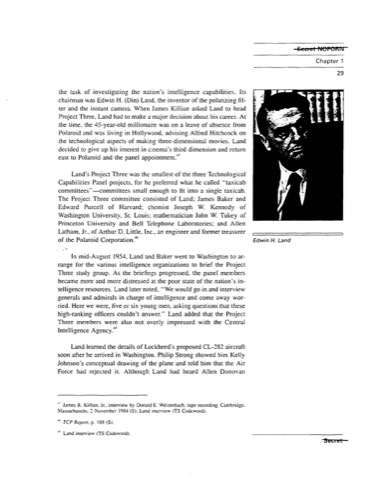
Image from page 42 of CIA-UAP-003, as released by war.gov
Image from page 42 of the PDF. Open the scan to see the whole page.

Cite this page

Central Intelligence Agency. "The Central Intelligence Agency and Overhead Reconnaissance; The U-2 and OXCART Programs, 1954-1974" (CIA-UAP-003). PURSUE Release 03, U.S. Department of War, June 12, 2026. https://www.war.gov/medialink/ufo/061226/release_03/documents/CIA-UAP-003-THE_CENTRAL_INTELLIGENCE_AGENCY_AND_OVERHEAD_RECONNAISSANCE-THE_U-2_AND_OXCART_PROGRAMS_1954-1974.pdf. Declassified UAP, page 42, https://declassifieduap.org/r/cia-uap-003-the-central-intelligence-agency-and-overhead-reconnaissance-the-u-2-and-oxcart-programs-1954-1974/p/42. Accessed November 28, 2026.

This address shows page 42 on its own; /r/cia-uap-003-the-central-intelligence-agency-and-overhead-reconnaissance-the-u-2-and-oxcart-programs-1954-1974?page=42 opens the same page in the full reader. Both stay. How to cite.