CIA-UAP-003

The Central Intelligence Agency and Overhead Reconnaissance; The U-2 and OXCART Programs, 1954-1974, page 40

One page of a U.S. government record released under PURSUE, shown on its own with its text. The record page has the whole document, its catalog details and the scan.

Page
40 of 406
Agency
CIA
Released
Release 03, June 12, 2026

Text of page 40

Gardner, the committee members decided to approach President Eisenhower on the matter. On 27 March 1954. the President told them about the discovery of the Soviet Bison bombers and his concern that these new aircraft might be used in a surprise attack on the United States. Stressing the high priority he gave to reducing the risk of mili- tary surprise, the President asked the committee to advise him on this The President's request led Chairman DuBridge to ask one of the most prominent members. MIT President James R. Killian, Jr., to meet with other Science Advisory Committee members in the Boston area to discuss the feasibility of a comprehensive scientific assess- ment of the nation's defenses. At their meeting at MIT on 15 April 1954, the group called for the recruitment of such a task force if the President endorsed the concept. On 26 July 1954. President Eisenhower authorized Killian to re- cruit and lead a panel of experts to study "the country's technologi- cal capabilities to meet some of its current problems." Killian quickly set up shop in offices located in the Old Executive Office Building and organized 42 of the nation's leading scientists into three special project groups investigating US offensive, defensive. and intelligence capabilites, with an additional communications working group (see chart. page 28). The Technological Capabilities Panel (TCP) groups began meeting on 13 September 1954. For the next 20 weeks, the members of the various panels met on 307 sepa- rate occasions for briefings, field trips, conferences, and meetings with every major unit of the US defense and intelligence establish- ments. After receiving the most up-to-date information available on the sation efeit repo no lie ational Samsity Counel members Project Three Support for the Lockheed CL-282 Even before the final Technological Capabilities Panel report was ready, one of the three working groups took actions that would have a major impact on the US reconnaissance program. Project Three had " Beschloss. Mayday, pp. 73-74: Technological Capabilities Panel of the Science dvisory Committee, Meeting the Threat of Surprise Attack, 14 February 1955. p. 18: hereafter cited as TCP Renort) (TS/Restricted Data, downgraded to S * James R. Killian, Jr.. Sputnik. Scientists, und Eisenhower: A Memoir of the First Special Assistant to the President for Science and Technology (Cambridge: MIT Press. 1977), p. 68: Beschloss, Mayday: p. 74: TCP Report. pp. 185-186 (S). Seeret NOFORN Chapter 1 27 James R. Killian, Jr. Seeret-

Machine-read (OCR) from the scan by this archive; it can contain errors. The scan is the record.
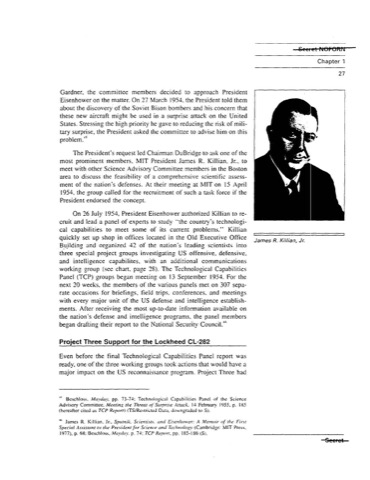
Image from page 40 of CIA-UAP-003, as released by war.gov
Image from page 40 of the PDF. Open the scan to see the whole page.

Cite this page

Central Intelligence Agency. "The Central Intelligence Agency and Overhead Reconnaissance; The U-2 and OXCART Programs, 1954-1974" (CIA-UAP-003). PURSUE Release 03, U.S. Department of War, June 12, 2026. https://www.war.gov/medialink/ufo/061226/release_03/documents/CIA-UAP-003-THE_CENTRAL_INTELLIGENCE_AGENCY_AND_OVERHEAD_RECONNAISSANCE-THE_U-2_AND_OXCART_PROGRAMS_1954-1974.pdf. Declassified UAP, page 40, https://declassifieduap.org/r/cia-uap-003-the-central-intelligence-agency-and-overhead-reconnaissance-the-u-2-and-oxcart-programs-1954-1974/p/40. Accessed November 28, 2026.

This address shows page 40 on its own; /r/cia-uap-003-the-central-intelligence-agency-and-overhead-reconnaissance-the-u-2-and-oxcart-programs-1954-1974?page=40 opens the same page in the full reader. Both stay. How to cite.