CIA-UAP-003

The Central Intelligence Agency and Overhead Reconnaissance; The U-2 and OXCART Programs, 1954-1974, page 37

One page of a U.S. government record released under PURSUE, shown on its own with its text. The record page has the whole document, its catalog details and the scan.

Page
37 of 406
Agency
CIA
Released
Release 03, June 12, 2026

Text of page 37

Secret NOFORN Chapter 1 24 Allen F. Donovan Baker also chaired the next meeting of the Air Force's Intelligence Systems Panel in late April 1954 but could not tell its members about the British overflight of Kapustin Yar because they were not cleared for this information. The panel did, however, discuss the modifications for high-altitude flight being made to the US Canberra, the B-57.* The Intelligence Systems Panel and the CL-282 The next Intelligence Systems Panel meeting took place on 24 and 25 May at Boston University and the Polaroid Corporation. Panel mem- ber Allen F. Donovan from the Cornell Aeronautical Laboratory eval- uated the changes being made to the B-57 by the Martin Aircraft Company. Even without Martin's specifications or drawings, Donovan had been able to estimate what could be done to the B-57 by lengthening the wings and lightening the fuselage. He had determined that alterations to the B-57 airframe would not solve the reconnais- sance needs expressed in the BEACON HILL Report. Theoretically, he explained to the panel, any multiengine aircraft built according to military specifications, including the B-57, would be too heavy to fly above 65,000 feet and hence would be vulnerable to Soviet intercep- tion. To be safe, Donovan explained, penetrating aircraft would need to fly above 70,000 feet for the entire mission." Development of such an aircraft was already under way, Donovan continued, for Philip Strong of the CIA had told him that the Lockheed Aircraft Corporation had designed a lightweight, high-fly- ing aircraft. ISP chairman Baker then urged Donovan to travel to southern California to evaluate the Lockheed design and gather ideas on high-altitude aircraft from other aircraft manufacturers. When he was finally able to make this trip in late summer, Donovan found the plane that he and the other ISP members had been seeking. On the afternoon of 2 August 1954, Donovan met with L. Eugene Root, an old Air Force acquaintance who was now a Lockheed vice-president, and learned about the Air Force's competi- tion for a high-altitude reconnaissance aircraft. Kelly Johnson then showed Donovan the plans for Lockheed's unsuccessful entry. A life- long sailplane enthusiast. Donovan immediately recognized that the " Baker interview (S). • Donovan interview (S): Baker interview (S). Seeret

Machine-read (OCR) from the scan by this archive; it can contain errors. The scan is the record.
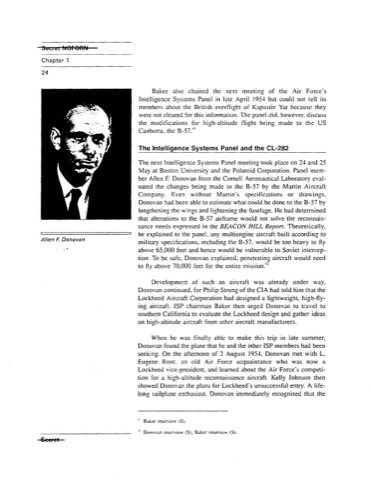
Image from page 37 of CIA-UAP-003, as released by war.gov
Image from page 37 of the PDF. Open the scan to see the whole page.

Cite this page

Central Intelligence Agency. "The Central Intelligence Agency and Overhead Reconnaissance; The U-2 and OXCART Programs, 1954-1974" (CIA-UAP-003). PURSUE Release 03, U.S. Department of War, June 12, 2026. https://www.war.gov/medialink/ufo/061226/release_03/documents/CIA-UAP-003-THE_CENTRAL_INTELLIGENCE_AGENCY_AND_OVERHEAD_RECONNAISSANCE-THE_U-2_AND_OXCART_PROGRAMS_1954-1974.pdf. Declassified UAP, page 37, https://declassifieduap.org/r/cia-uap-003-the-central-intelligence-agency-and-overhead-reconnaissance-the-u-2-and-oxcart-programs-1954-1974/p/37. Accessed November 28, 2026.

This address shows page 37 on its own; /r/cia-uap-003-the-central-intelligence-agency-and-overhead-reconnaissance-the-u-2-and-oxcart-programs-1954-1974?page=37 opens the same page in the full reader. Both stay. How to cite.