CIA-UAP-003

The Central Intelligence Agency and Overhead Reconnaissance; The U-2 and OXCART Programs, 1954-1974, page 30

One page of a U.S. government record released under PURSUE, shown on its own with its text. The record page has the whole document, its catalog details and the scan.

Page
30 of 406
Agency
CIA
Released
Release 03, June 12, 2026

Text of page 30

Moreover, high-altitude reconnaissance of the Soviet Union did not fit well into Allen Dulles's perception of the proper role of an intelli- gence agency. He tended to favor the classical form of espionage. which relied on agents rather than technology." At this point, the summer of 1954, Lockheed's CL-282 proposal still lacked official support. Although the design had strong backers among some Air Force civilians and CIA officials, the key decisionmakers at both Air Force and CIA remained unconvinced. To make Kelly Johnson's revolutionary design a reality, one additional source of support was necessary: prominent scientists serving on gov- emment advisory boards. SCIENTISTS AND OVERHEAD RECONNAISSANCE Scientists and engineers from universities and private industry had played a major role in advising the government on technical matters during World War II. At the end of the war, most of the scientific ad- visory boards were disbanded, but within a few years the growing tensions of the Cold War again led government agencies to seek sci- entific advice and assistance. In 1947 the Air Force established a Scientific Advisory Board, which met periodically to discuss topics of current interest and advise the Air Force on the potential usefulness of new technologies. The following year the Office of Defense Mobilization established the Scientific Advisory Committee, but the Truman administration made little use of this new advisory body." The BEACON HILL Report In 1951 the Air Force sought even more assistance from scientists be- cause the Strategic Air Command's requests for information about targets behind the Iron Curtain could not be filled. To look for new ways of conducting reconnaissance against the Soviet Bloc, the Air Force's Deputy Chief of Staff for Development, Maj. Gen. Gordon P. Saville, added 15 reconnaissance experts to an existing project on air * Powers. Man Who Kept the Secrets. pp. 103-104: Edwin H. Land. interview by Donald Welzenbach, tape recording, Cambridge, Massachusetts. 17 and 20 September 19: S Codeword): Robert Amory. Jr. interview by Donald E. Welzenbach and Gregorv Pedlow, Washington, DC, 22 April 1987 (S). " For more information on the Air Force's use of scientists see Thomas A. Sturn. Th /SAF Scientific Advison Board• Its First Twenn Years, 1914-1964 (Washington. DC USAF Historical Office, 1967) (U). Secret NOFORN Chapter 1 17 DCI Allen W. Dulles Secret

Machine-read (OCR) from the scan by this archive; it can contain errors. The scan is the record.
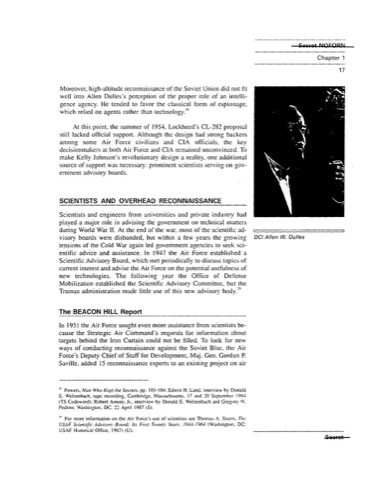
Image from page 30 of CIA-UAP-003, as released by war.gov
Image from page 30 of the PDF. Open the scan to see the whole page.

Cite this page

Central Intelligence Agency. "The Central Intelligence Agency and Overhead Reconnaissance; The U-2 and OXCART Programs, 1954-1974" (CIA-UAP-003). PURSUE Release 03, U.S. Department of War, June 12, 2026. https://www.war.gov/medialink/ufo/061226/release_03/documents/CIA-UAP-003-THE_CENTRAL_INTELLIGENCE_AGENCY_AND_OVERHEAD_RECONNAISSANCE-THE_U-2_AND_OXCART_PROGRAMS_1954-1974.pdf. Declassified UAP, page 30, https://declassifieduap.org/r/cia-uap-003-the-central-intelligence-agency-and-overhead-reconnaissance-the-u-2-and-oxcart-programs-1954-1974/p/30. Accessed November 28, 2026.

This address shows page 30 on its own; /r/cia-uap-003-the-central-intelligence-agency-and-overhead-reconnaissance-the-u-2-and-oxcart-programs-1954-1974?page=30 opens the same page in the full reader. Both stay. How to cite.