CIA-UAP-003

The Central Intelligence Agency and Overhead Reconnaissance; The U-2 and OXCART Programs, 1954-1974, page 290

One page of a U.S. government record released under PURSUE, shown on its own with its text. The record page has the whole document, its catalog details and the scan.

Page
290 of 406
Agency
CIA
Released
Release 03, June 12, 2026

Text of page 290

Seeret NOFORA Chapter 6 277 eventually to the fuselage itself. creating what is known as a chine on each side. At first Johnson was concerned that these additions might impair the airworthiness of the plane, but wind tunnel testing deter- nined that the chines actually imparted a useful aerodynamic lift t he vehicle. Because titanium was very brittle and therefore difficul to bend, Johnson achieved the necessary curvature by combining tri- angular-shaped pieces of titanium called fillets. These fillets were glued to the framework of the chines with a special adhesive, epoxy resin. On later OXCART models the fillets were made from electri- cally resistive honeycomb plastic with a glass-fiber surface that would not melt at high speed. When struck by a radar pulse, the com- posite chines tended to absorb the pulse rather than reflect it. A simi- lar approach was used for the leading edges of the wings. Again electrically resistive honeycomb material was fabricated into triangu- lar shapes, known as wing teeth, and fitted into the titanium wings. Both the metal and composite fillets and teeth were held in place with the newly developed epoxy cements. The greatest remaining area of concern in the A-12's radar cross section was the two vertical stabilizers. To reduce radar reflections, Kelly Johnson canted the stabilizers inward 15 and fabricated them out of resin-impregnated nonmetallic materials. Once these changes were completed, the only metal in each vertical stabilizer was a stain- less steel pivot. The Air Force, which later ordered several versions of the OXCART aircraft for its own use. never adopted the laminated vertical stabilizers. THE OXCART CONTRACT By mid-January 1960, Lockheed had demonstrated that its concept of shape, fuel additive, and nonmetallic parts would reduce the OXCART's radar cross section substantially. Richard Bissell, howev- er, was very upset to learn that the changes had led to a reduction in the aircraft's performance, which meant it would not be able to attain the penetration altitude he had promised to President Eisenhower. Kelly Johnson then proposed to reduce the aircraft's weight by 1,000 pounds and increase the fuel load by 2.000 pounds, making it possible " Johnson. "Development of Lockheed SR-71. pp. 6-7: OSA History, chap. 20. p. 35 (TS Codeword). Secret

Machine-read (OCR) from the scan by this archive; it can contain errors. The scan is the record.
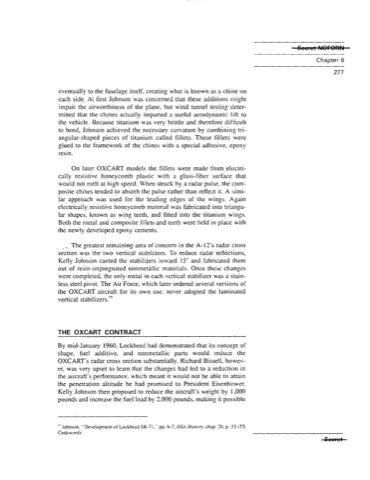
Image from page 290 of CIA-UAP-003, as released by war.gov
Image from page 290 of the PDF. Open the scan to see the whole page.

Cite this page

Central Intelligence Agency. "The Central Intelligence Agency and Overhead Reconnaissance; The U-2 and OXCART Programs, 1954-1974" (CIA-UAP-003). PURSUE Release 03, U.S. Department of War, June 12, 2026. https://www.war.gov/medialink/ufo/061226/release_03/documents/CIA-UAP-003-THE_CENTRAL_INTELLIGENCE_AGENCY_AND_OVERHEAD_RECONNAISSANCE-THE_U-2_AND_OXCART_PROGRAMS_1954-1974.pdf. Declassified UAP, page 290, https://declassifieduap.org/r/cia-uap-003-the-central-intelligence-agency-and-overhead-reconnaissance-the-u-2-and-oxcart-programs-1954-1974/p/290. Accessed November 28, 2026.

This address shows page 290 on its own; /r/cia-uap-003-the-central-intelligence-agency-and-overhead-reconnaissance-the-u-2-and-oxcart-programs-1954-1974?page=290 opens the same page in the full reader. Both stay. How to cite.