Text of page 214
of the nature of the Soviet buildup in Cuba. Two days after the mis-
sion, the CIA reported in the President's Intelligence Checklist that
there were at least eight surface-to-air missile (SA-2) sites in the
western half of Cuba."
(The map on page 202 shows the routes taken
by the two August overflights.)
On 5 September the next U-2 overflight (mission 3089) provided
more evidence of the Soviet buildup. The mission's photography
showed three more SAM sites and also revealed a MiG-21, one of the
newest Soviet fighter aircraft, at the Santa Clara airfield.
The discovery of SAMs in Cuba had a twofold effect on the US
reconnaissance effort over Cuba. First, it added substance to DCI
McCone's fears that Cuba might become a base for Soviet medi-
um-range ballistic missiles (he argued that SAM sites would only be
set up to protect high-priority facilities such as missile bases). At this
time, however, McCone's suspicions were not shared by other offi-
cials in the Agency or the administration. The second and most signif-
icant effect of the discovery of SAMs in Cuba was to make the
administration far more cautious in its use of U-2s for reconnaissance
of the island. As the loss of Francis Gary Powers' U-2 in May 1960
had demonstrated, the U-2 was very vulnerable to the SA-2 missile.
Within the administration, concern mounted about the U-2's vul-
nerability to SAMs in Cuba and the possibility that a loss could cause
a major diplomatic crisis. Such fears increased as the result of two
incidents in other parts of the world. On 30 August 1962, a SAC U-2
on a peripheral reconnaissance mission overflew Sakhalin Island in
the Far East, prompting a Soviet protest on 4 September. The United
States apologized for the intrusion. Then on 8 September, a U-2 with
a Nationalist Chinese pilot was shot down over the People's Republic
of China (this CIA reconnaissance program is discussed later in this
chapter in the section on Asian operations). Increasing concern about
U-2 vulnerability led to an impromptu meeting on 10 September 1962
of Secretary of State Dean Rusk,
National Security Adviser
McGeorge Bundy, and DDCI Marshall S. Carter (in place of the DCI,
who was on his honeymoon in France). The Secretary of State ob-
jected to the CIA's plans for two extended overflights covering the re-
naining areas of Cuba not covered by the last two missions. Rusl
vanted peripheral flights over international waters kept separate fron
* Richard Lehman. *CIA Handling of the Soviet Buildup in Cuba, 1 July-16 October
1962."
14 November 1962 (Hereafter cited as Lehman Report). DCI records. job
80-B- 1676R, box 17, folder 18 (TS Codeword).
-Secret NOFORN
Chapter 5
201
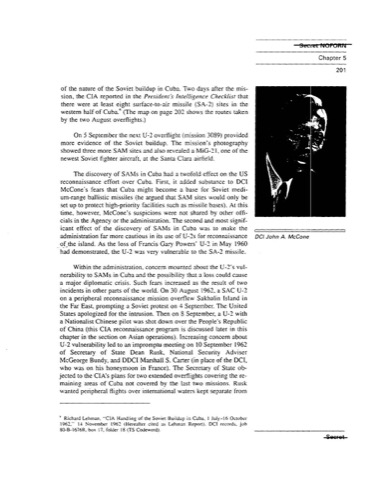
DCI John A. McCone
Secret