CIA-UAP-003

The Central Intelligence Agency and Overhead Reconnaissance; The U-2 and OXCART Programs, 1954-1974, page 21

One page of a U.S. government record released under PURSUE, shown on its own with its text. The record page has the whole document, its catalog details and the scan.

Page
21 of 406
Agency
CIA
Released
Release 03, June 12, 2026

Text of page 21

Seeret NOFORA Chapter 1 8 The Air Force Search for a New Reconnaissance Aircraft With interest in high-altitude reconnaissance growing, several Air Force agencies began to develop an aircraft to conduct such mis- ions. In September 1952, the Air Research and Developmer ommand gave the Martin Aircraft Company a contract to examin the high-altitude potential of the B-57 by modifying a single aircraft to give it long, high-lift wings and the American version of the new Rolls-Royce Avon-109 engine. These were the modifications that Richard Leghorn had suggested during the previous year." At about the same time, another Air Force office, the Wright Air Development Command (WADC) in Dayton, Ohio, was also examin- ing ways to achieve sustained flight at high altitudes. Working with two German aeronautical experts—-Woldemar Voigt and Richard Vogt-who had come to the United States after World War II, Air Force Maj. John Seaberg advocated the development of a new aircraft that would combine the high-altitude performance of the latest turbo- jet engines with high-efficiency wings in order to reach ultrahigh alti- tudes. Seaberg, an aeronautical engineer for the Chance Vought Corporation until his recall to active duty during the Korean war, was serving as assistant chief of the New Developments Office of WADC's Bombardment Branch. By March 1953, Seaberg had expanded his ideas for a high-alti- tude aircraft into a complete request for proposal for "an aircraft weapon system having an operational radius of 1,500 nm [nautical miles] and capable of conducting pre- and post-strike reconnaissance missions during daylight, good visibility conditions." The require- ment stated that such an aircraft must have an optimum subsonic cruise speed at altitudes of 70,000 feet or higher over the target, carry a payload of 100 to 700 pounds of reconnaissance equipment, and have a crew of one." The Wright Air Development Command decided not to seek pro- posals from major airframe manufacturers on the grounds that a smaller company would give the new project a higher priority and Philip G. Strong, Chief, Operations Staff. OSI, Memorandum for the Record. "Recor aissance Capabilities," 21 August 1953, OSt records (S " Jay Miller, Lockheed U-2, Aerograph 3 (Austin, Texas: Aerofax, 1983). p. 10. -Seeret

Machine-read (OCR) from the scan by this archive; it can contain errors. The scan is the record.
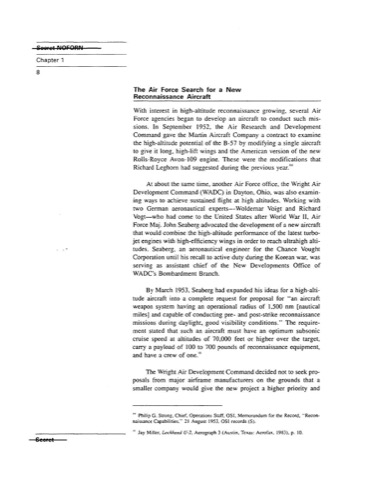
Image from page 21 of CIA-UAP-003, as released by war.gov
Image from page 21 of the PDF. Open the scan to see the whole page.

Cite this page

Central Intelligence Agency. "The Central Intelligence Agency and Overhead Reconnaissance; The U-2 and OXCART Programs, 1954-1974" (CIA-UAP-003). PURSUE Release 03, U.S. Department of War, June 12, 2026. https://www.war.gov/medialink/ufo/061226/release_03/documents/CIA-UAP-003-THE_CENTRAL_INTELLIGENCE_AGENCY_AND_OVERHEAD_RECONNAISSANCE-THE_U-2_AND_OXCART_PROGRAMS_1954-1974.pdf. Declassified UAP, page 21, https://declassifieduap.org/r/cia-uap-003-the-central-intelligence-agency-and-overhead-reconnaissance-the-u-2-and-oxcart-programs-1954-1974/p/21. Accessed November 28, 2026.

This address shows page 21 on its own; /r/cia-uap-003-the-central-intelligence-agency-and-overhead-reconnaissance-the-u-2-and-oxcart-programs-1954-1974?page=21 opens the same page in the full reader. Both stay. How to cite.