Text of page 18
Secret NOFOAN
Chapter 1
5
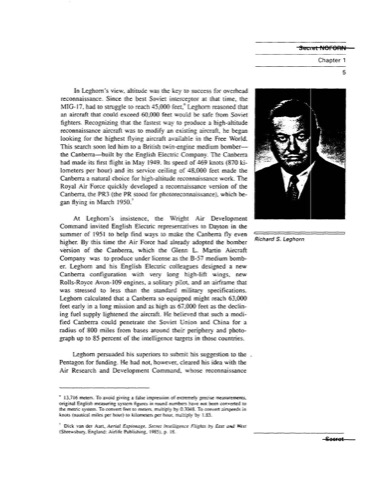
In Leghorn's view, altitude was the key to success for overhead
reconnaissance. Since the best Soviet interceptor at that time, the
MIG-17, had to struggle to reach 45,000 feet," Leghorn reasoned that
an aircraft that could exceed 60,000 feet would be safe from Soviet
fighters. Recognizing that the fastest way to produce a high-altitude
reconnaissance aircraft was to modify an existing aircraft, he began
looking for the highest flying aircraft available in the Free World.
This search soon led him to a British twin-engine medium bomber—
the Canberra-built by the English Electric Company. The Canberra
had made its first flight in May 1949. Its speed of 469 knots (870 ki-
lometers per hour) and its service ceiling of 48,000 feet made the
Canberra a natural choice for high-altitude reconnaissance work. The
Royal Air Force quickly developed a reconnaissance version of the
Canberra, the PR3 (the PR stood for photoreconnaissance), which be-
gan flying in March 1950.'
At Leghorn's insistence, the Wright Air Development
Command invited English Electric representatives to Dayton in the
summer of 195l to help find ways to make the Canberra fly even
higher. By this time the Air Force had already adopted the bomber
version of the Canberra, which the Glenn L. Martin Aircraft
Company was to produce under license as the B-57 medium bomb-
er. Leghorn and his English Electric colleagues designed a new
Canberra configuration with very long high-lift wings, new
Rolls-Royce Avon-109 engines, a solitary pilot, and an airframe that
was stressed to less than the standard military specifications.
Leghor calculated that a Canberra so equipped might reach 63,000
feet early in a long mission and as high as 67,000 feet as the declin-
ing fuel supply lightened the aircraft. He believed that such a modi-
fied Canberra could penetrate the Soviet Union and China for a
radius of 800 miles from bases
around their periphery and photo-
graph up to 85 percent of the intelligence targets in those countries.
Leghor persuaded his superiors to submit his suggestion to the .
Pentagon for funding. He had not, however, cleared his idea with the
Air Research and Development Command, whose reconnaissance
Richard S. Leghorn
• 13.716 meters. To avoid giving a faise impression of extremely precise measurements.
original English measuring system figures in round numbers have not been converted to
the metric system. To convert feet to meters, multiply by 0.3048. To convert airspeeds in
knots (nautical miles per hour) to kilometers per hour, multiply by 1.85.
Dick van der Aart. Aerial Espionage. Secret Intelligence Flichts by East und We.
Shrewsbury. England: Airlife Publishing. 1985). p. 1
-SeGret