CIA-UAP-003

The Central Intelligence Agency and Overhead Reconnaissance; The U-2 and OXCART Programs, 1954-1974, page 172

One page of a U.S. government record released under PURSUE, shown on its own with its text. The record page has the whole document, its catalog details and the scan.

Page
172 of 406
Agency
CIA
Released
Release 03, June 12, 2026

Text of page 172

—Secret NOFORN Chapter 4 159 The Final Overflights of the Soviet Union, 1959-1960 THE U-2 AND THE "MISSILE-GAP" DEBATE Despite President Eisenhower's reluctance to send U-2s over the Soviet Bloc, he once again authorized overflights in the summer of 1959, after a pause of more than a year. The overriding factor in his decision was the growing "missile-gap" controversy, which had its roots in a series of dramatic Soviet announcements during the second half of 1957. The first announcement revealed the successful test of an intercontinental ballistic missile in August. Then in October, the Soviets announced the successful orbiting of the world's first artificial earth satellite, Sputnik. One month later the Soviets orbited a second satellite containing a dog and a television camera. To many Americans, including some influential members of Congress, the Soviet Union's space successes seemed to indicate that its missile program was ahead of that of the United States. By the spring of 1958, after the United States had successfully launched several satel- lites, fears of a space technology gap between the two superpowers had eased. By the end of the year, however, new concerns arose that the Soviet Union was producing a missile arsenal that would be much larger than that of the United States. This was the famous missile gap that received widespread publicity beginning in early 1959' The missile-gap controversy was fueled by Soviet boasts about the success of their missile program. On 4 December 1958, a Sovier delegate to the Geneva Conference on Surprise Attack stated: "Soviet ICBMs are at present in mass production." Five days later, Soviet For an overview of the controversy, see Roy E. Licklider, "The Missile Gap Controversy." Political Science Quarterly 85 (1970):600-615. Secret

Machine-read (OCR) from the scan by this archive; it can contain errors. The scan is the record.
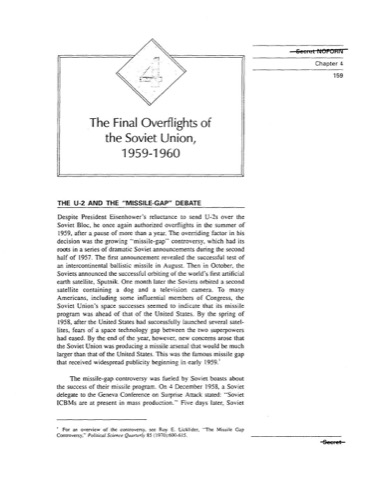
Image from page 172 of CIA-UAP-003, as released by war.gov
Image from page 172 of the PDF. Open the scan to see the whole page.

Cite this page

Central Intelligence Agency. "The Central Intelligence Agency and Overhead Reconnaissance; The U-2 and OXCART Programs, 1954-1974" (CIA-UAP-003). PURSUE Release 03, U.S. Department of War, June 12, 2026. https://www.war.gov/medialink/ufo/061226/release_03/documents/CIA-UAP-003-THE_CENTRAL_INTELLIGENCE_AGENCY_AND_OVERHEAD_RECONNAISSANCE-THE_U-2_AND_OXCART_PROGRAMS_1954-1974.pdf. Declassified UAP, page 172, https://declassifieduap.org/r/cia-uap-003-the-central-intelligence-agency-and-overhead-reconnaissance-the-u-2-and-oxcart-programs-1954-1974/p/172. Accessed November 28, 2026.

This address shows page 172 on its own; /r/cia-uap-003-the-central-intelligence-agency-and-overhead-reconnaissance-the-u-2-and-oxcart-programs-1954-1974?page=172 opens the same page in the full reader. Both stay. How to cite.