CIA-UAP-003

The Central Intelligence Agency and Overhead Reconnaissance; The U-2 and OXCART Programs, 1954-1974, page 14

One page of a U.S. government record released under PURSUE, shown on its own with its text. The record page has the whole document, its catalog details and the scan.

Page
14 of 406
Agency
CIA
Released
Release 03, June 12, 2026

Text of page 14

-Seeret NOFORN Chapter 1 Searching for a System THE NEED FOR HIGH-ALTITUDE RECONNAISSANCE For centuries, soldiers in wartime have sought the highest ground or structure in order to get a better view of the enemy. At first it was tail trees, then church steeples and bell towers. By the time of the American Civil War and the Franco-Prussian War of 1870-71, ob- servers were using hot-air balloons to get up in the sky for a better view of the "other side of the hill." With the advent of dry film, it became possible to carry cameras into the sky to record the disposi- tion of enemy troops and emplacements. Indeed, photoreconnaissance proved so valuable during World War I that in 1938 Gen. Werner von Fritsch, Commander in Chief of the German Army, predicted: "The nation with the best aerial reconnaissance facilities will win the next war. " ! By World War II, lenses, films, and cameras had undergone many improvements, as had the airplane, which could fly higher and faster an the primitive craft of World War I. Now it was possible to us hotoreconnaissance to obtain information about potential targets br fore a bombing raid and to assess the effectiveness of the bombing afterward. Peacetime applications of high-altitude photography at first in- cluded only photomapping and surveying for transcontinental high- ways and mineral and oil exploration. There was little thought given to using photography for peacetime espionage until after World War II, when the Iron Curtain rang down and cut off most forms of communi- cation between the Soviet Bloc of nations and the rest of the world. ' Roy M. Stanley II, World War Il Photo Intelligence (New York: Scribners, 1981), p. 16. Secret

Machine-read (OCR) from the scan by this archive; it can contain errors. The scan is the record.
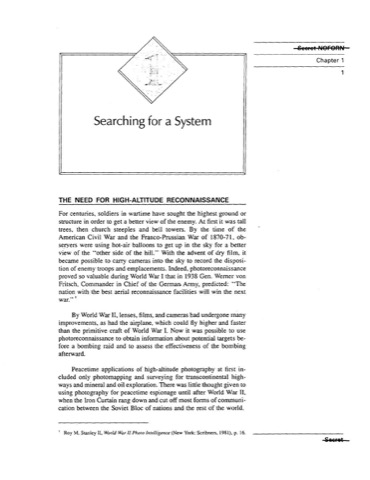
Image from page 14 of CIA-UAP-003, as released by war.gov
Image from page 14 of the PDF. Open the scan to see the whole page.

Cite this page

Central Intelligence Agency. "The Central Intelligence Agency and Overhead Reconnaissance; The U-2 and OXCART Programs, 1954-1974" (CIA-UAP-003). PURSUE Release 03, U.S. Department of War, June 12, 2026. https://www.war.gov/medialink/ufo/061226/release_03/documents/CIA-UAP-003-THE_CENTRAL_INTELLIGENCE_AGENCY_AND_OVERHEAD_RECONNAISSANCE-THE_U-2_AND_OXCART_PROGRAMS_1954-1974.pdf. Declassified UAP, page 14, https://declassifieduap.org/r/cia-uap-003-the-central-intelligence-agency-and-overhead-reconnaissance-the-u-2-and-oxcart-programs-1954-1974/p/14. Accessed November 28, 2026.

This address shows page 14 on its own; /r/cia-uap-003-the-central-intelligence-agency-and-overhead-reconnaissance-the-u-2-and-oxcart-programs-1954-1974?page=14 opens the same page in the full reader. Both stay. How to cite.