CIA-UAP-003

The Central Intelligence Agency and Overhead Reconnaissance; The U-2 and OXCART Programs, 1954-1974, page 134

One page of a U.S. government record released under PURSUE, shown on its own with its text. The record page has the whole document, its catalog details and the scan.

Page
134 of 406
Agency
CIA
Released
Release 03, June 12, 2026

Text of page 134

Secret NOFORA Chapter 3 121 facilities available, and the film had to be flown to Wiesbaden, adding a 10- to 15-hour delay. During the gradual buildup of the crisis, this delay had been tolerated, but, once actual hostilities broke out, US decisionmakers needed a more rapid response. On 29 October, Richard Bissell ordered Lundahl to establish a film-processing facility it Adana. Two PID employees went to Adana on 13 November to se 1p the facility, and two photointerpreters moved from Wiesbaden t dana to help in the effort. Forward processing was, however, ham ered by the location of the Adana facility on a flat, arid plain i southern Turkey, 35 miles from the Mediterranean at the very end of a long supply line. The PID team obtained and outfitted a trailer for film processing, but many problems had to be overcome. The first major problem was obtaining enough clean water. Detachment B personnel, therefore, purchased large amounts of borax locally for use in purifying water. In fact, they bought so much borax on the local market that one of them was arrested by the Turkish police, who believed he was using the chemical to make drugs. It was also difficult to obtain a constant source of developers and fixers for processing the U-2 film, since the large Air Force supply facility at Wheelus AFB in Libya refused to provide the needed photographic chemicals. When PID personnel ac- companied processed film from Turkey to the United States, they re- turned to Turkey sitting atop cartons of chemicals for the next day's processing. At first, film was developed in improvised tanks using flimsy wooden spools and hand-turned cranks to move the film through the solutions. Later, the Adana facility moved from its trailer to a building and received more up-to-date processing equipment. As was the case with the photo lab in Germany, the Adana lab's person- nel came from the Agency and the armed forces. The need to produce very timely intelligence diminished after the British and French agreed to a cease-fire on 7 November 1956. By the end of the month, foreign troops began evacuating Egyptian terri- tory, and the pressure on the Adana photointerpretation unit eased. The facility remained in existence, however, and was used twice in December 1956 and I1 times in the first half of 1957. It was then placed in caretaker status, for emergency use only. " NPIC History, vol. 1, pp. 53-54 (S): Lundahl and Brugioni interview (TS Codeword). Secret

Machine-read (OCR) from the scan by this archive; it can contain errors. The scan is the record.
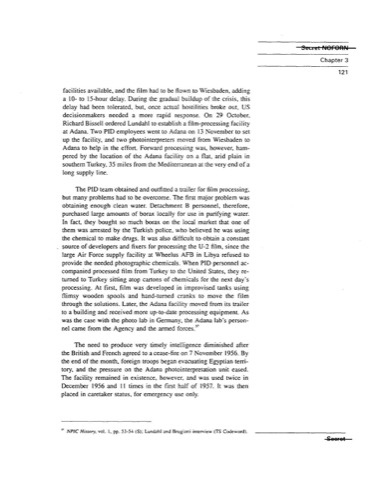
Image from page 134 of CIA-UAP-003, as released by war.gov
Image from page 134 of the PDF. Open the scan to see the whole page.

Cite this page

Central Intelligence Agency. "The Central Intelligence Agency and Overhead Reconnaissance; The U-2 and OXCART Programs, 1954-1974" (CIA-UAP-003). PURSUE Release 03, U.S. Department of War, June 12, 2026. https://www.war.gov/medialink/ufo/061226/release_03/documents/CIA-UAP-003-THE_CENTRAL_INTELLIGENCE_AGENCY_AND_OVERHEAD_RECONNAISSANCE-THE_U-2_AND_OXCART_PROGRAMS_1954-1974.pdf. Declassified UAP, page 134, https://declassifieduap.org/r/cia-uap-003-the-central-intelligence-agency-and-overhead-reconnaissance-the-u-2-and-oxcart-programs-1954-1974/p/134. Accessed November 28, 2026.

This address shows page 134 on its own; /r/cia-uap-003-the-central-intelligence-agency-and-overhead-reconnaissance-the-u-2-and-oxcart-programs-1954-1974?page=134 opens the same page in the full reader. Both stay. How to cite.