CIA-UAP-003

The Central Intelligence Agency and Overhead Reconnaissance; The U-2 and OXCART Programs, 1954-1974, page 128

One page of a U.S. government record released under PURSUE, shown on its own with its text. The record page has the whole document, its catalog details and the scan.

Page
128 of 406
Agency
CIA
Released
Release 03, June 12, 2026

Text of page 128

-Secret NOFORN Chapter 3 115 The Suez Crisis was a major turning point in the use of the U-2 airplane. Before this crisis, the U-2 had been seen solely as a collecto f strategic intelligence, with high-quality results considered more important than speed. U-2 film had, therefore, been returned to the ploitation), therefore, had to arrange for forward processing of the U-2 film to avoid unacceptable delays in providing intelligence on tactical developments around Suez. PID acted quickly to carry out its new assignment. Lundahl and Reber flew from the United Kingdom to US Air Force Europe head- quarters in Wiesbaden on 12 September to make arrangements for processing and interpreting U-2 film in West Germany. They had been preceded by chief of PID's Special Projects Branch. Following detailed discussions with Air Force photo- -intelligence personnel, the CIA representatives arranged to use a por- tion of a nearby Air Force photo laboratory for developing U-2 film. With the assistance of chief of the TAUTOMAT photo laboratory, and Air Force personnel, had the lab ready for processing on the following day, when the next U-2 mission returned from the Middle East. After quickly developing the film, and his joint staff of CIA and armed forces personnel stud. ied it for indications of British and French preparations for hostilities and sent their first report to Washington on 15 September. Although the Air Force provided considerable assistance in es- tablishing photo laboratory, Air Force officials did not like the idea of CIA personnel controlling overseas photo processing and interpretation centers, which were normally under Air Force con- trol. Further negotiations led to a CIA-Air Force agreement at the end of October, under which the Air Force would name the commanding officer for such installations and the CIA would designate the deputy, who was responsible for technical and intelligence matters.* PID soon added two photointerpreters and a lab technician to the West German operation, which continued to develop and interpret U-2 photography of the Middle East throughout September and * Ibid., pp. 49-52 (S). Seeret

Machine-read (OCR) from the scan by this archive; it can contain errors. The scan is the record.
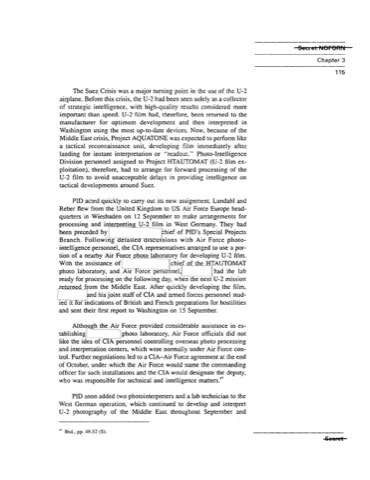
Image from page 128 of CIA-UAP-003, as released by war.gov
Image from page 128 of the PDF. Open the scan to see the whole page.

Cite this page

Central Intelligence Agency. "The Central Intelligence Agency and Overhead Reconnaissance; The U-2 and OXCART Programs, 1954-1974" (CIA-UAP-003). PURSUE Release 03, U.S. Department of War, June 12, 2026. https://www.war.gov/medialink/ufo/061226/release_03/documents/CIA-UAP-003-THE_CENTRAL_INTELLIGENCE_AGENCY_AND_OVERHEAD_RECONNAISSANCE-THE_U-2_AND_OXCART_PROGRAMS_1954-1974.pdf. Declassified UAP, page 128, https://declassifieduap.org/r/cia-uap-003-the-central-intelligence-agency-and-overhead-reconnaissance-the-u-2-and-oxcart-programs-1954-1974/p/128. Accessed November 28, 2026.

This address shows page 128 on its own; /r/cia-uap-003-the-central-intelligence-agency-and-overhead-reconnaissance-the-u-2-and-oxcart-programs-1954-1974?page=128 opens the same page in the full reader. Both stay. How to cite.