65_HS1-834228961_62-HQ-83894_SUB_A, page 75
One page of a U.S. government record released under PURSUE, shown on its own with its text. The record page has the whole document, its catalog details and the scan.
- Page
- 75 of 124
- Agency
- FBI
- Released
- Release 01, May 8, 2026
Text of page 75
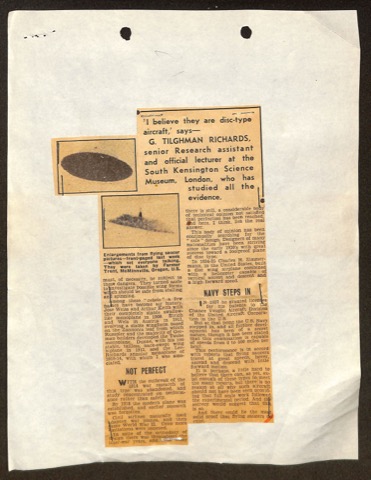
Enlargements from flying saucer
pictures-front-paged
last
week
-which
set
everyone
talking.
They
were
taken
Farmer
Trent, McMinnville, Oregon, U.S.
must,
of necessity, be subject to
these
dangers.
They turned aside
to investigate possible wing forms
which should be safe from stalling
ani spinning.
mong
these " rebels"
a few
names have
become air history.
Jose Weiss and Arthur Keith with
their completely
stable
swallow-
like
monoplane
in
Austria
1909.1n
Etrich
1911,
and
Wels
evolving
1n
a stable wingform based
on the Zannonia leaf from which
Rumpler and the majority of Ger-
man builders developed the Taube
monoplane.
Dunne,
with his too
stable,
tailless.
wing
biplane in
1912,
back-awthe Lee-
and
Richards annular
monoplane
1910-14, with
which I was
asso-
ciated.
NOT PERFECT
WITH the outbreak of the
1914
war
research
this
type
was
abandoned,
and
study concentrated on perform-
ance rather than safety.
By 1918 the modern plane was
established,
and earlier research
was forgotten.
Civil airlines
naturally
daptea
war
and
used
then
ame World War II.
planes, Once more
Imitations were imposed.
In
spite of
the orthodoxy
of
there was throughout uns
inter-war
years,
and
'I believe they are disc-type
aircraft, says—
G. TILGHMAN RICHARDS,
senior Research assistant
and official lecturer at the
South Kensington Science
Museum,
London, who has
studied all the
evidence.
there is still, a considerable body
of technical opinion not satisfied
that perfection has been reached
And
here.
I think.
lies
the real
answer.
This body of opinion has been
continually
searching
for
the
safe "
design. Designers of many
nationalities have
been
striving
since
the early 1920's with
great
success toward a foolproof
plane
of disc
type.
In 1934-35 Charles H.
Zimmer-
mann, in the United States,
built
disc
wing
airplane
combined
of
with
helicopter
capable
vertical
ascent
and descent and
a high forward speed.
NAVY STEPS IN
IN
1937 he granted licentes
for
patents
Chance
Vought
Aircraft Division
of the
United Aircraft Corpora-
tion in the U.S
But at that point the J.S. Navy
stepped in, and all further
devel-
ooment
nature,
has
been
secret
though it has been stated
that this
combination
is capable
of speeds from 0 to 500 miles per
hour.
This performance is in
accord
with
reports
that
flying
saucers
travel
at
ascend
and desc
speeas,
hover,
descend
with
little
forward motion.
It is
perhaps, a little hard to
believe that there can, as yet, ex-
ist enough of these types to meet
the many reports, but there is no
reason
all why
such
aireraft
should not have been seen provid-
ing
that full scale work followed
the experimental period.
And the
secrecy
would
suggest
that thi
is so.
And there could lie
sauce mod
solid proof that flying saucers
exist.
Machine-read (OCR) from the scan by this archive; it can contain errors. The scan is the record.
Cite this page
Federal Bureau of Investigation. "65_HS1-834228961_62-HQ-83894_SUB_A". PURSUE Release 01, U.S. Department of War, May 8, 2026. https://www.war.gov/medialink/ufo/release_1/65_hs1-834228961_62-hq-83894_sub_a.pdf. Declassified UAP, page 75, https://declassifieduap.org/r/65_hs1-834228961_62-hq-83894_sub_a/p/75. Accessed November 28, 2026.
This address shows page 75 on its own; /r/65_hs1-834228961_62-hq-83894_sub_a?page=75 opens the same page in the full reader. Both stay. How to cite.