65_HS1-834228961_62-HQ-83894_SUB_A, page 21
One page of a U.S. government record released under PURSUE, shown on its own with its text. The record page has the whole document, its catalog details and the scan.
- Page
- 21 of 124
- Agency
- FBI
- Released
- Release 01, May 8, 2026
Text of page 21
-
DEE
RTMENT OF THE AIR FORCE
Office of Public Information
Washington 25, D. c.
ONTA
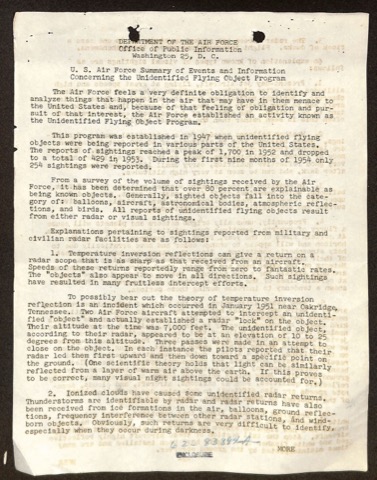
U. S. Air Force Summary of Events and Information
Concerning the Unidentified Flying Object Program
The Air Force feels a very definite obligation to identify and
analyze things that happen in the air that may have in them menace to
the United States and, because of that feeling of obligation and pur-
sult of that interest, the Air Force established an activity known as
the Unidentified Flying, Object Program.
This program was established in 1947 when unidentified flying
objects were being reported in various parts of the United States.
The reports of. sightings reached a peak of 1,700 in 1952 and dropped
to a total of 429 in 1953. During the first nine months of 1954 only
254 sightings were reported.
From a survey of the volume of sightings received by the Air
Force, it has been determined that over 80 percent are explainable as
being
known objects. Generally, sighted objects fall into the cate-
gory of: balloons,
aircraft, astronomical bodies, atmospheric reflec-
tions, and birds.
All reports of unidentified flying objects result
from either radar or visual sightings.
Explanations pertaining to sightings reported from military and
civilian radar facilities are as follows:
1. Temperature inversion reflections can give a return on a
radar scope that is as sharp as that received from an aircraft..
Speeds of these returns reportedly range from zero to fantastic rates.
The "objects" also appear to move in all directions. Such sightings
have resulted in many fruitless intercept efforts.
To possibly bear out the theory of temperature inversion
reflection is an incident which occurred in January 1951 near Oakridge,
Tennessee.i
Two Air Force aircraft attempted to intercept an unidenti-
fied "object" and actually established a radar "lock" on the object.
Their altitude at the time was 7,000 feet.
The unidentifled object,
according to their radar, appeared to be at an elevation of 10 to 25
degrees from this altitude.
Three passes were made in an attempt to
close on the object. In each instance the pilots reported that their
radar led them first upward and then down toward a specific point on
the ground. (One scientifie theory holds that light can be similarly
reflected from a layer of warm air above the earth.
If this proves
to be correct, many visual night sightings could be accounted for.)
Ionized clouds have caused some unidentified radar returns.
Thunderstorms are identifiable by radar and radar returns have also
been received from ice formations in the air, balloons, ground reflec-
tions, frequency interference between other radar stations, and wind-
born objects.
Obviously, such returns are very difficult to identify,
especially when they occur during darkness.
83894-4
MORE
ENCNOSAIRE
Machine-read (OCR) from the scan by this archive; it can contain errors. The scan is the record.
Cite this page
Federal Bureau of Investigation. "65_HS1-834228961_62-HQ-83894_SUB_A". PURSUE Release 01, U.S. Department of War, May 8, 2026. https://www.war.gov/medialink/ufo/release_1/65_hs1-834228961_62-hq-83894_sub_a.pdf. Declassified UAP, page 21, https://declassifieduap.org/r/65_hs1-834228961_62-hq-83894_sub_a/p/21. Accessed November 28, 2026.
This address shows page 21 on its own; /r/65_hs1-834228961_62-hq-83894_sub_a?page=21 opens the same page in the full reader. Both stay. How to cite.