Text of page 106
ADDRESS REPLY TO
- DIRECTOR, NAVAL RESEARCH LABORATO
WASHINGTON 20, D. C.
AND REFER TO:
Code 110
ARMY LIAISON OFFICE
NAVY DEPARTMENT
NAVAL RESEARCH LABORATORY
WASHINGTON 20, D.C.
BIR
18 July 1947
SUBJECT: Interviev of Person Reporting Unidentifled Aerial Objeet
TO:
Asst Chief of Air Staff-2
Collection Branch, AAF
Washington 25, D. C.
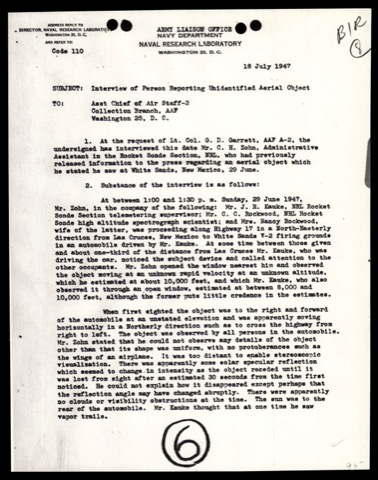
1. At the request of It. Col. G. D. Garrett, AAF A-2, the
undersigned has interviewed this date Mr. C. H. Zohn, Administrative
Assistant in the Rocket Sonde Section, NRL, who had previously
released information to the press regarding an aerial object which
he stated he saw at White Sands, New Mexico, 29 June.
2. Substance of the interview is as follows:
At between 1:00 and 1:30 p.m. Sunday, 29 June 1947,
Mr. Zohn, in the company of the following: Mr. J. R. Kauke, NRL Rocket
Sonde Section telemetering supervisor; Mr. C. C. Rockwood, NRL Rocket
Sonde high altitude spectrograph scientist; and Mrs. Naney Rockwood,
wife of the latter, was proceeding along Highway 17 in a North-Easterly
direction from Las Cruces, New Mexico to White Sands V-2 firing grounds
in an automobile driven by Mr. Kauke. At some time between those given
and about one-third of the distance from Las Cruces Mr. Kauke, who was
driving the ear, noticed the subject device and called attention to the
other occapants. Mr. Zohn opened the window nearest him and observed
the object moving at an unknown rapid velocity at an unknown altitude,
which he estimated at about 10,000 feet, and which Mr. Kauke, who also
observed it through an open window, estimated at between 8,000 and
10,000 feet, although the former puts little credence in the estimates.
When firet sighted the object was to the right and forward
of the automobile at an unstated elevation and was apparently moving
horizontally in a Northerly direction such as to cross the highway from
right to left. The object was observed by all persons in the automobile.
Mr. Zohn stated that he could not observe any details of the object
other than that 1ts shape was uniform, with no protuberances sch as
the wings of an airplane. It was too distant to epable stereoscopie
visualization. There was apparently some solar specular reflection
which seemed to change. in intensity as the object receded until it
was lost from sight after an estimated 30 seconds from the time first
noticed. He could not explain how it disappeared except perhaps that
the reflection angle may have changed abruptly. There were apparently
no clouds or visibility obstructions at the time. The sun was to the
rear of the automobile. Mr. Kauke thought that at one time he saw
vapor trails.
6