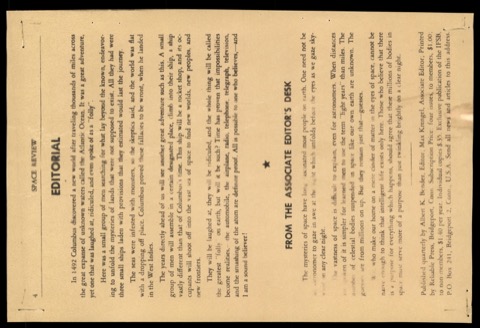
Text of page 117
SPACE REVIEW
EDITORIAL
In 1492 Columbus discovered a new world after traveling thousands of miles across
the great expanse of unknown waters called the Atlantic Ocean. It was a great adventure,
yet one that was laughed at, ridiculed, and even spoke of as a "folly"
Here was a small group of men searching for what lay beyond the known, endeavor-
ing to unfold the mysteries of lands that were not supposed to exist. All they had were
three small ships laden with provisions that they estimated would last the journey.
The seas were infested with monsters, so the skeptics said, and the world was flat
with a dropping off place. Columbus proved these fallacies to be wront, when he landed
in the West Indies.
The years directly ahead of us will see another great adventure such as this. A small
group of men will assemble in a certain designated place, climb into their ship, a ship
vastly different than that of Columbus's time. This ship will be a rocket shop, and its oc-
cupants will shoot off into the vast sea of space to find new worlds, new peoples, and
new frontiers.
They will be laughed at, they will be ridiculed, and the whole thing will be called
the greatest "folly on earth, but will it be such? Time has proven that impossibilities
become realities,- the automobile, the airplane, radio, telephone, telegraph, television,
and the smashing of the atom are definite proof. All is possible to one who believes, —and
I am a sound believer!
*
FROM THE ASSOCIATE EDITOR'S DESK
The mysteries of space have long fascinated most people on earth. One need not be
astronomer to gaze in awe at the wight which unfolds before the eyes as we gaze sky-
on any clear night.
he vastness of space is difficult to explain, even for astronomers. When distances
ken of it is simpler for learned men to use the term "light years" than miles. The
of celestial bodies suspended in space like our own earth are unknown. The
are from millions on up. But they remain just that-guesses.
who make our home on a mere cinder of matter in the eyes of space, cannot be
naive enough to think that intelligent life exists only here. Those who believe that there
is a purpose for everything which happens, should agree that these millions of bodies in
space must serve more of a purpose than just twinkling brightly on a clear night.
Published quarterly by Albert K. Bender, Editor; Max Krengel, Associate Editor; Printed
by Reliable Press, Bridgeport, Conn. Subscription Price: four issues, to members, $1.00;
to non members, $1.40 per year. Individual copies $.35. Exclusive publication of the IFSB
P.O. Box 241, Bridgeport 2, Conn., U.S.A. Send all news and articles to this address.