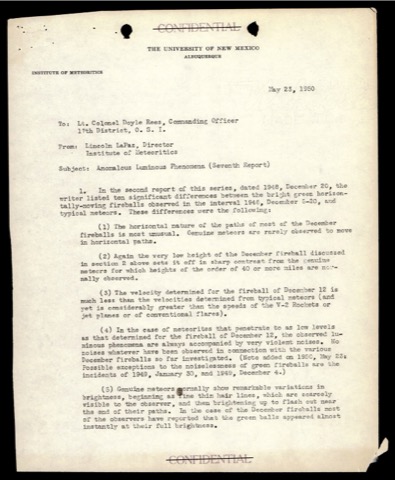
Text of page 27
CON
THE UNIVERSITY OF NEW MEXICO
ALBUQUERQUE
INSTITUTE OF METEORITICS
May 23, 1950
To :
Li. Colonel Doyle Rees, Commanding Officer
17th District, o. S. I.
From: Lincoln LaPaz, Director
Institute of Meteoritics
Subject: Anomalous Luminous Phenomena (Seventh Report)
1.
In the second report of this series, dated 1948, December 20, the
writer listed ten significant differences between the bright green horizon-
tally-moving fireballs observed in the interval 1948, December 5-20, and
typical meteors. These differences were the
following:
(1) The horizontal nature of the paths of most of the December
fireballs is most unusual. Genuine meteors are rarely observed to move
in horizontal paths.
(2) Again the very low height of the December fireball discussed
in section 2 above sets it off in sharp contrast from the genuine
meteors for which heights of the order of 40 or more miles are no.*-
mally observed.
(3) The velocity determined for the fireball of December 12 is
much less than the velocities determined from typical meteors (and
yet is considerably greater than the speeds of the V-2 Rockets or
jet planes or of conventional flares).
(4) In the case of meteorites that penetrate to as low levels
as that determined for the fireball of December 12, the observed lu-
minous phenomena are always accompanied by very violent noises.
No
noises whatever have been observed in connection with the various
December fireballs so far investigated. (Note added on 1950, May 23:
Possible exceptions to the noiselessness of green fireballs are the
incidents of 1949, January 30, and 1949, December 4.)
(5) Genuine meteors mornally show remarkable variations in
brightness, beginning as fine thin hair lines, which are scarcely
visible to
the observer, and then brightening up to flash out near
the end of their paths.
In the case of the December firoballs most
of the observers have reported that the green balls appeared almost
instantly at their full brightness.
TAL