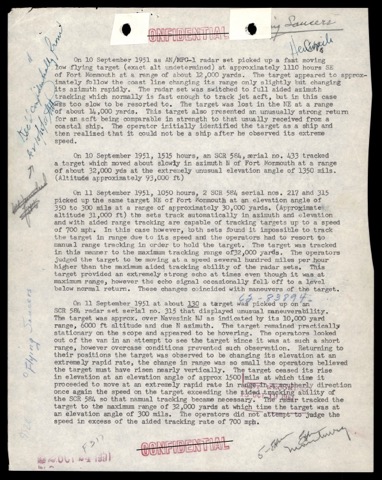
Text of page 130
, 0
2
Flying Sau
cers
Saucers
NFIDENTIA:
LUM 4
Delogies
On 10 September 1951 as AN/MPG-1 radar set picked up a fast moving
Tow flying target (exact alt undetermined) at approximately 1110 hours SE
of Fort Monmouth at a range of about 12,000 yards.
The target appeared to approx-
imately follow the coast line changing its range only slightly but changing
its azimuth rapidly.
The radar set was switched to full aided azimuth
tracking which normally is fast enough to track jet aft, but in this case
was too slow to be resorted to. The target was lost in the NE at a range
of about 14,000 yards.
This target also presented an unusually strong return
for an acft being comparable in strength to that usually received from a
coastal ship.
The operator initially identified the target as a ship and
then realized that it could not be a ship after he observed its extreme
On 10 September 1951, 1515 hours, an SCR 584, serial no. 433 tracked
a target which moved about slowly in azimuth N of Fort Mormouth at a range
of about 32,000 yds at the extremely unusual elevation angle of 1350 mils.
(Altitude approxinately 93,000 ft)
On 11 September 1951, 1050 hours, 2 SCR 584 serial nos. 217 and 315
picked up the same target NE of Fort Monmouth at an elevation angle of
350 to 300 mils at a range of approximately 30,000 yards. (Approximate
altitude 31,000 ft) the sets track automatically in azimuth and elevation
and with aided range tracking are capable of tracking targets up to a speed
of 700 mph. In this case however, both sets found it impossible to track
the target in range due to its speed and the operators had to resort to
judged the target to be moving at a speed several hundred miles per hour
target provided an extremely strong echo at times even though it was at
maximum range, however the echo signal occasionally fell off to a level
below normal return. These changes coincided with maneuvers of the target.
On 11 September 1951 at about 130 a target was picked up on
-83894
SCR 584 radar set serial no. 315 that displayed unusual maneuverability.
The target was approx. over Navesink NJ as indicated by its 10,000 yard
range, 6000 ft altitude and due N azimuth. The target remained practically
stationary on the scope and appeared to be hovering.
The operators looked
out of the van in an attempt to see the target since it was at such a short
range, however overcase conditions prevented such observation.
Returning to
their positions the target was observed to be changing its elevation at an
extremely rapid rate, the change in range was so small the operators believed
the target must have risen nearly vertically.
The target ceased its rise
in elevation at an elevation angle of approx 1500 mils at which time it
proceeded to move at an extremely rapid rate in range in 4.89utherly direction
once again the speed on the target exceeding the aided tracking ability of
the SCR 584 so that namual tracking became necessary.
The radar tracked the
target to the maximum range of 32,000 yards at which time the target was at
an elevation angle of 300 mils.
The operators did not attempt to judge the
speed in excess of the aided tracking rate of 700 mph.
CONFIDENTIAL
6.001 04 1031