Text of page 100
-U. S. News & World Rep
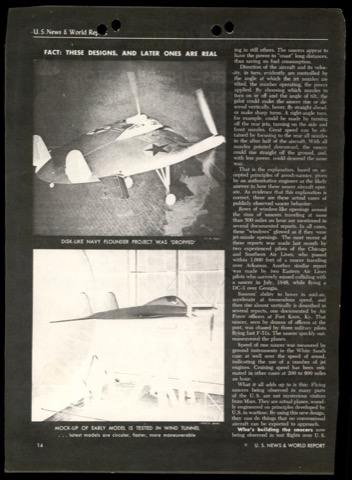
FACT: THESE DESIGNS, AND LATER ONES ARE REAL
DISK-LIKE NAVY FLOUNDER PROJECT WAS 'DROPPED'
-NACA photo
MOCK-UP OF EARLY MODEL IS TESTED IN WIND TUNNEL
... latest models are circular, faster, more maneuverable
ing in still others. The saucers appear to
have the power to "coast" long distances,
thus saving on fuel consumption.
Direction of the aircraft and its veloc-
•ity, in turn, evidently are controlled by
the angle at which the jet nozzles are
tilted, the number operating, the power
applied. By choosing which nozzles to
turn on or off and the angle of tilt, the
pilot could make the saucer rise or de-
scend vertically, hover, fly straight ahead
or make sharp turns. A right-angle turn.
for example, could be made by turning
off the rear jets, turning on the side and
front nozzles. Great speed can be ob
tained by focusing to the rear all novales
in the after half of the aircraft. With all
nozzles pointed downward, the saucer
could rise straight off the ground, and,
with less power, could descend the same
way.
That is the explanation,
based on ac-
cepted principles of aerodynamics, given
by an authoritative engineer as the likely
answer to how these saucer aircraft oper-
ate. As evidence that this explanation is
correct, there are these actual cases of
publicly observed saucer behavior:
Rows of window-like openings around
the rims of saucers traveling at more
than 500 miles an hour are mentioned in
several documented reports. In all cases,
these "windows"
glowed as if they were
jet-nozzle openings. The most recent of
these reports was made last month by
two experienced pilots of the Chicago
and
Southern Air Lines, who passed
within 1,000 feet of a saucer traveling
over
Arkansas.
Another similar report
was made
by two Eastern Air Lines
pilots who narrowly missed colliding with
a saucer in July, 1948, while flying a
DC-S over Georgia.
Saucers ability to hover in mid-air
accelerate
at tremendous speed, and
then rise almost vertically is described in
several reports, one documented by Air
Force officers at Fort Knox, Ky. That
saucer, seen by dozens of officers at the
post, was chased by three military pilots
flying fast F-51s. The saucer quickly out-
maneuvered the planes.
Speed of one saucer was measured by
ground instruments in the White Sands
case
at well over the speed of sound,
indicating the use of a number of jet
engines. Cruising speed has been esti-
mated in other cases at 200 to 600 miles
an hour.
What it all adds up to is this: Flying
saucers being observed in many parts
of the U.S. are not mysterious visitors
from Mars. They are actual planes, sound-
ly engineered on principles developed by
U.S. in wartime. By using this new design,
they can do things that no conventional
aircraft can be expected to approach.
Who's building the saucers now
being observed in test flights over U.S.
U. S. NEWS & WORLD REPORT