Text of page 178
Flying Saucers Come from Southern California
Do YOU HAVE spots before your eyes? Do vari-colored
An intesting part of the story is that producing the
discs flutter and sail in the air in front of you? Do you
acetate "Flyin' Saucer" is only part of the story. It is a
see flying saucers in the skies?
product with a wide market (how many yo-yos were sold
If you do, don't call the doctor nor jump on the wagon.
in the US last ear, do you suppose?); but it must be
And don't worry. Other persons are seeing flying saucers
demonstrated to be
sold.
Everyone who sees a Flyin
too seeing them fly through the air-and seeing them
Saucer in
action is enthusiastic.
Anyone who sees one
on the sales counters of the stores.
You can even pick
lying on a sales counter is likely to pass by.
them up and feel them, and, preferably, buy them to play
That presents a merchandising problem that has the
sales staff of Southern California Plastic hard at work,
It all started many years ago long before the recent
thinking up ways and means for demonstrations, action
flurry of flying saucers-when a little boy named Freddie
publicity, visual promotional stunts. With a record of
used to play with his mother's pie tins. If he threw them
steady-selling
staple consumer items now on the market,
with just the right twist of the wrist, they spun and turned
Southern California has no intention of letting the Flyin'
in fascinating curves.
Saucers
sit on the sales counters. Carefully-controlled
Freddie grew up into a man called Fred Morrison, who
distribution, related to on-the-spot demonstrations or pro-
always remembered what fun he had had playing with the
motional campaigns, has been the rule so far.
National
pie tins.
As a grown-up, he applied his knowledge of
markets will not be tackled until all the promotional kinks
erodynamics to the problem of developing a disc which
have been unraveled.
ould be thrown an
tossed and its flight controlled by
the thrower.
He evolved a metal model that sailed through the air
in a most satisfactory manner. The curved disc was 9 in.
in diameter and a scant 2 in. deep, with radiating arc-
shapped fins and a heavy outside rim. A snap of the wrist
when throwing gives a centrifugal motion to the
disc
which in turn gives guidance in flight.
The radial fins
create a vacuum on top of the whirling disc, and stability
from beneath is provided by the heavy rim.
The metal model sailed through the air beautifully.
but also, being
metal, it sailed through windows and
hedges and other obstacles, somewhat after the manner of
a miniature cyclone. A material other than metal seemed
a wise idea if the discor flying saucer—were to become
a commercial product.
A lightweight, slightly flexible plastics looked like the
answer, and Morrison brought his metal model to Southern
California Plastic Co., Glendale, Calif., to see what might
be done in plastics. Stanley J. Gray and Edward L. Ken-
nedy, president and secretary of the firm, took the metal
disc out on the lawn to
and
were
soon breathlessly convinced that a great
of fun could be had by young and old alike.
A plastics model of the disc was carved from a solid
block of material, and then a mold made in the shop of
Southern California.
Engraving of the mold
was done
by United Engravers, Los Angeles.
Then came the problem of the right material. A search
was made throughout the range of thermoplastic molding
compounds to find the proper material that combined
flexibility, impact strength, and stability while in motion.
(The discs achieve considerable speed--and strain-when
in flight.) Cellulose acetate provided the best combination
of properties to do the job. Acetate discs will not break
glass windows, nor shatter when falling from a great
height, nor scar the finish on automobiles, nor injure the
players.
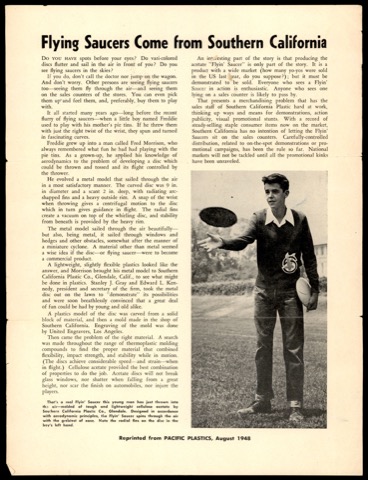
That's a real Flyin' Saucer this
young man has just thrown into
and lightweight cellulose acetate
California Plastic Co., Glendale.
Designed in accordance
with aerodynamic principles, the Flyin' Saucer spins through the air
with the greatest of ease.
Note the radial fins on the
boy's left hand.
Reprinted from PACIFIC PLASTICS, August 1948