Text of page 26
STANDARD
AL NO. 64
Office Memo
•VUM • UNITED SIA.~-
jOVERNMENT
TO
FROM
SUBJECT:
Director
6 FBI
SAC, Boston
атем
DATE:
7-29-47
Fletcher
METAL FRAGMENTS
OBSERVED AT WEST RINDGE, NEW HAMPSHIRE, JULY 7, 1947
SECURITY MATTER
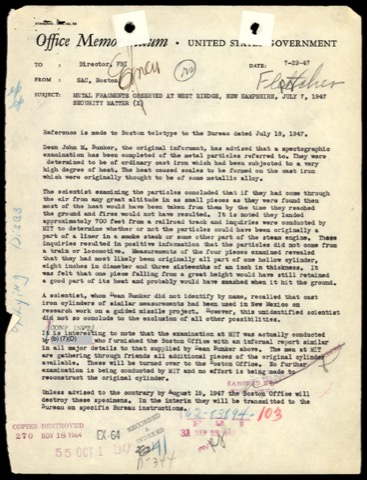
Referenoe is made to Boston teletype to the Bureau dated July 18, 1947.
Dean John M. Bunker, the original informant, has advised that a spectographic
examination has been completed of the metal partioles referred to. They were
determined to be of ordinary cast iron which had been subjected to a very
high degree of heat. The heat caused scales to be formed on the cast iron
which were originally thought to be of some metallio alloy
The scientist exemining the partioles concluded that if they had come through
the air from any great altitude in as small pieces as they were found then
0g
the ground and fires would not have resulted. It is noted they landed
approximatoly 700 feet from a railroad traok and inquiries were conducted by
MIT to deternine whether or not the particles could have been originally a
part of a liner in a smoke stack or sone other part of the stean engine. These
inquiries resulted in positive information that the particles did not come from
a train or locomotive. Measurements of the four pieces examined revealed
that they had most likely been originally all part of one hollow cylinder,
eight inches in diemeter and three sixteenths of an inch in thiokness. It
was felt that one piece falling from a great height would have still retained
a good part of its heat and probably would have smashed when it hit the ground.
A soientist, whom Dean Bunker did not identify by name, recalled that oast
iron oylinders of similar measurements had been used in New Mexico on
research work on a guided missile project. However, this unidentified soientist
did not so conclude to the exolusion of all other possibilities.
CONF. INFT.)
It is
by (b) (7)(D)
interesting to note that the examination at MIT was aotually conducted
who furnished the Boston Office with an informal report similar
in all major details to that supplied by Dean Bunker above. The men at MIT
are gathering through friends all additional pieces of the original cylinder
available.
These will be turned over to the
Poston Office. No further
examination is being conduoted by MIT and no effort is being made to
reconstruot the original cylinder•
BANDIED
Unless advised to the contrary by August 15, 1947 the Boston Office will
COPIES DESTROYED
San on polio brai introsion 2 - 13894=103
dostroy these specimens. In the interim they will be transnitted to the
270 NOV 18 1964
EX-64
RECORDED
INDEXHD
341 SEP 29
55 0СT 1 134/
1-34