Text of page 170
TA T
COPY
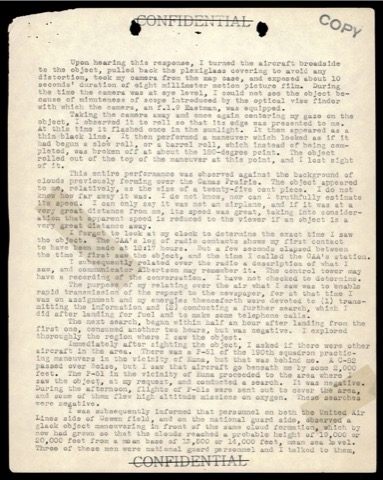
Upon hearing this response, I turned the aircraft broadside
to the object, pulled back the plexiglass covering to avoid any
distortion, took my camera from the map case, and exposed about 10
seconds' duration of eight millimeter motion picture film. During
the time the camera was at eye level, I could not see the object be-
cause of minuteness of scope introduced by the optical view finder
with which the camera, an f.1.9 Eastman, was equipped.
Taking the camera away and once again centering my gaze on the
object,
I observed it to roll so that its edge was presented to me.
At this time it flashed once in the sunlight. It then appeared as
thin black line. It then performed a maneuver which looked as if it
had begun a slow roll, or a barrel roll, which instead of being com-
pleted, was broken off at about the 180-degree point. The object
rolled out of the top of the maneuver at this point, and I lost sight
This entire performance was observed against the background of
clouds previously forming over the Camas Prairie.
The object appeared
to me, relatively,
as the size of a twenty-five cent piece.
I do not
know how far away
it was. I do not know, nor can I truthfully estimate
Its speed. I can only say it was not an airplane, and if it was at a
very great distance from me, its speed was great,
taking into consider-
ation that apparent speed is reduced to the viewer if an object is a
very great distance away.
I forgot to look at my clock to determine the exact time I saw
the object.
The CAA's log of radio contacts shows my first contact
to have been made at 12:17 hours. But a few seconds elapsed between
the time I first saw the object, and the time I called the CAA's station.
I subsequently related over the radio a description of what I
saw, and communicator Albertson may remember it.
The control tower may
have a recording of the conversation.
I have not checked to determine.
The purpose of my relating over the air what I saw was to enable
rapid transmission of the report to the newspaper, for at that time I
was on assignment and my energies thenceforth were devoted to (1) trans-
mitting the information and (2) conducting a further search, which I
did after landing for fuel and to make some telephone calls.
The next search, begun within half an hour after landing from the
first one, consumed another two hours, but was negative. I explored
thoroughly the region where I saw the
object.
Immediately after sighting the object, I asked if there were other
aircraft in the area.
There was a P-51 of the 190th squadron practic-
ing maneuvers in the vicinity of Kuna, but that was behind me.
A C-82
passed over Boise, but I saw that aircraft go beneath me by some 2,000
feet.
The P-51 in the vicinity of Kuna proceeded to the area where I
saw the object, at my request, and conducted a search. It was negative.
During the afternoon, flights
of P-5ls were sent out to cover the area,
and some of them flew high altitude missions on oxygen. These searches
were negative.
I was subsequently informed that personnel on both the United Air
Lines side of Gowen field, and on the national guard side, observed a
glack object maneuvering in front of the same cloud formation, which by
now had grown so that the clouds reached a probable height of 19,000 or
20,000 feet from a mean base of 13,500 or 14,000 feet, mean sea level.
Three of these men were national guard personnel and I talked to them,
CONFIDENTIAL